Sunday, September 30, 2012
A Beautiful Mind
Could you imagine not knowing what's real or imagined; not knowing that the little girl you've been having a conversation with for hours is just imagined; not knowing that your roommate you've shared the most stories with doesn't exist; not knowing that the loyal pet dog you've had all your life is just a figment of your imagination?
That's how schizophrenics live their daily lives. Due to an excessive amount of dopamine levels in their brain, they are overly sensitive to stimuli and perceive things that aren't truly there.
The movie A Beautiful Mind, directed by Julian Schnabel, helps capture the life of a schizophrenic. John Nash, played by Russell Crowe, is a Nobel Laureate in Economics who suffers from schizophrenia. He isn't the average schizophrenic though, he discovers that he has a mental illness on his own.
Russell Crowe, to better understand the character he was portraying, spent some time with John Nash. He said that John Nash is super intelligent and he would've never known that he was a schizophrenic because he acted so normal.
John Nash asked to stay off medicine because he knows he can handle his hallucinations. Still to this day he sees them, but they are part of his past now that he knows they are in his mind.
Normal schizophrenics need help to overcome their delusions and hallucinations. They need the assistance of strong prescribed drugs that will help them live their lives as normal.
The movie A Beautiful Mind really opened the eyes to people to know how schizophrenics are, and how they live their lives. Most schizophrenics are even more less fortunate than John Nash because they can't tell what is real or what is imagined.
Word of the Week: Schizophrenia: a severe mental disorder characterized by some, but not necessarily all, ofthe following features: emotional blunting, intellectualdeterioration, social isolation, disorganized speech andbehavior, delusions, and hallucinations. (dictionary.reference.com)
Sunday, September 16, 2012
What Do You See?
Welcome to the world of optical illusions (:
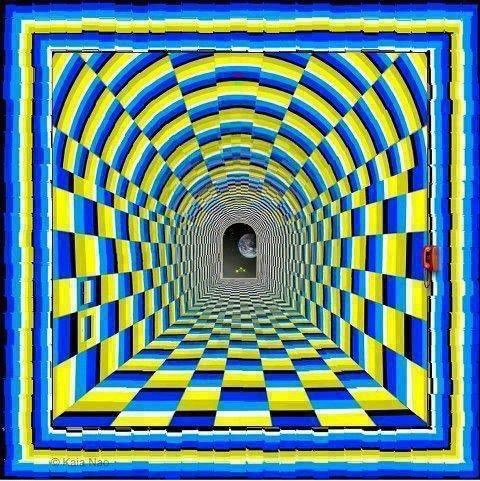
Have you ever caught your eyes playing tricks on you? You can blame that on your brain. Optical illusions are caused by your brain making assumptions on what it doesn't completely comprehend.
Pictures can be perceived differently by each individual depending on the way that certain individual's brain sees it. For example in the picture below:
Another way optical illusions work is by after images. After images are caused by the cones in your eyes over working and getting fatigued. They eventually adapt to the over stimulation of the certain color or colors being looked at. Stare at the black dot for 20 seconds then look away and let the after image brighten up your day.
In the picture below there is another neat example of this:
As you stare at the black cross in the middle of the circle you will start to see the a blue circle appear and then eventually the pink dots disappear all together.
Optical illusions are also caused by the colors around the object, just as you will see in the picture below:
Optical illusions are very interesting to observe, but it's also neat to find out what causes them. Our brains are funny things. They don't like when something doesn't make sense, so they fill it in themselves.
Did you know we all have a blind spot? Yes it's true. In our eyes there is a spot in our retina, the back of our eye, where the two nerves form the optic nerve. The optic nerve forms our blind spot, because there are no rod or cones in that area.
We never notice our blind spot because our brain fills it in for us. Still don't believe me? See for yourself.
Close your left eye and stare at the plus sign with your right eye. When the black dot disappears you have found your blind spot! You may need to get closer or further from the cross, but eventually the black dot will disappear. Info from http://serendip.brynmawr.edu/bb/blindspot1.html
As you can see there is plenty fun and educational things you can get from optical illusions.
Word of the Week:
Word of the Week:
perception: the act or faculty of apprehending by means of the sensesor of the mind; cognition; understanding.
Thursday, August 30, 2012
Falling into Autumn
Once again the time has come for all the intense football games, the crisp smell of leaves lingering in the air, the carving of pumpkins, the picking of apples, going to haunted to houses, and of course Halloween decorations. Although all that stuff sounds great, this year for me fall isn't going to be about all those fun events.
As much as I love going on hayrides, picking pumpkins, and eating candy corn, I have more to think about this fall.
Unfortunately, as a senior when fall comes that's when the college preparations start. I am forced to start thinking about what colleges I want to go to, start preparing for applications, getting teacher recommendations, maintaining good grades, and doing well on the ACT.
When I think about the list of things I need to complete it's overwhelming. It's hard to do all the things I need to do this fall with volleyball in the picture also. I feel like my life is now; wake up, go to school, go to volleyball, shower, eat, do homework, and get as much sleep as possible. I don't have time to do any of the fun events fall has to offer.
Fall being my favorite season, and it being my senior year, I want to make the most out of this year. Although I know school is my top priority right now, I need to have time to hangout with my friends and socialize. This is the last year I will get to spend with all my classmates before we all go our separate ways.
But how am I going to manage my social life and my school life with the busy schedule I have?
It's definitely going to be really tough, but I am determined to find time in my schedule to hang out with my friends. I don't know how. But it's going to happen.
Word Of The Week: Determination: the act of coming to a decision or of fixing or settling a purpose.
Subscribe to:
Posts (Atom)